
A post office RD calculator 2026 helps you find the maturity value and interest on your Post Office Recurring Deposit before you invest. Enter your monthly deposit and get the result instantly.
This guide explains the latest rate, how the postal RD calculator works, maturity for popular amounts like ₹1,000 and ₹5,000 per month, and the advance-deposit, premature-closure and loan features.
What Is a Post Office RD Calculator?
The Post Office Recurring Deposit (RD) is a small-savings scheme from India Post where you deposit a fixed amount every month for five years.
A post office RD calculator is a simple tool that applies the official quarterly-compounding formula for you, showing your maturity value and total interest in seconds.
Try our Post Office RD calculator for any amount — it works as an rd calculator, interest calculator and maturity calculator in one.
Post Office RD Interest Rate 2026
For 2026, the Post Office RD earns 6.70% per year, compounded quarterly. The rate is set by the government and reviewed every quarter.
The term is fixed at five years (60 monthly deposits), with a minimum of ₹100 per month in multiples of ₹10 and no maximum limit.
How the Post Office RD Calculator Works

Each monthly deposit earns interest that compounds every quarter. Because money is added monthly, the calculator uses India Post’s standard RD formula, not simple interest.
The formula is M = R × [(1+i)^n − 1] / [1 − (1+i)^(−1/3)], where R is the monthly deposit, i is the quarterly rate and n is the number of quarters.
Post Office RD Maturity by Monthly Deposit (₹500 to ₹5,000)
The table below shows what popular monthly amounts grow to over five years at 6.70%. Use it as a quick post office RD 1000 per month or 5000 per month reference.
| Monthly deposit | Invested (5 yr) | Interest | Maturity value |
| ₹500 | ₹30,000 | ₹5,683 | ₹35,683 |
| ₹1,000 | ₹60,000 | ₹11,366 | ₹71,366 |
| ₹1,500 | ₹90,000 | ₹17,049 | ₹1,07,049 |
| ₹2,000 | ₹1,20,000 | ₹22,732 | ₹1,42,732 |
| ₹5,000 | ₹3,00,000 | ₹56,829 | ₹3,56,829 |
| ₹10,000 | ₹6,00,000 | ₹1,13,658 | ₹7,13,658 |
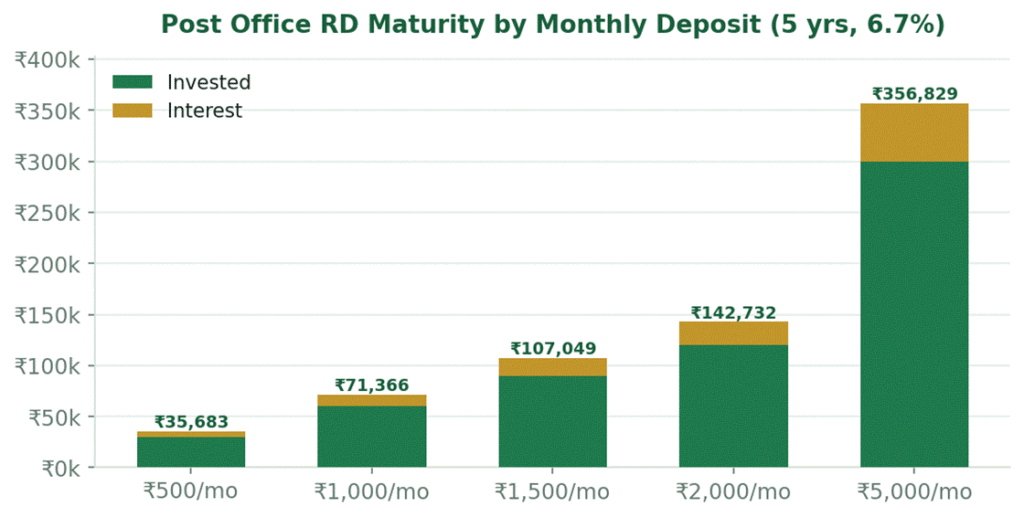
So a Post Office RD of ₹1,000 per month for 5 years gives about ₹71,366, and ₹5,000 per month grows to roughly ₹3,56,829.
Year-by-Year Growth of a Post Office RD
A recurring deposit grows slowly at first and faster later, as interest builds on a larger balance. The chart shows a ₹5,000 monthly RD over five years.
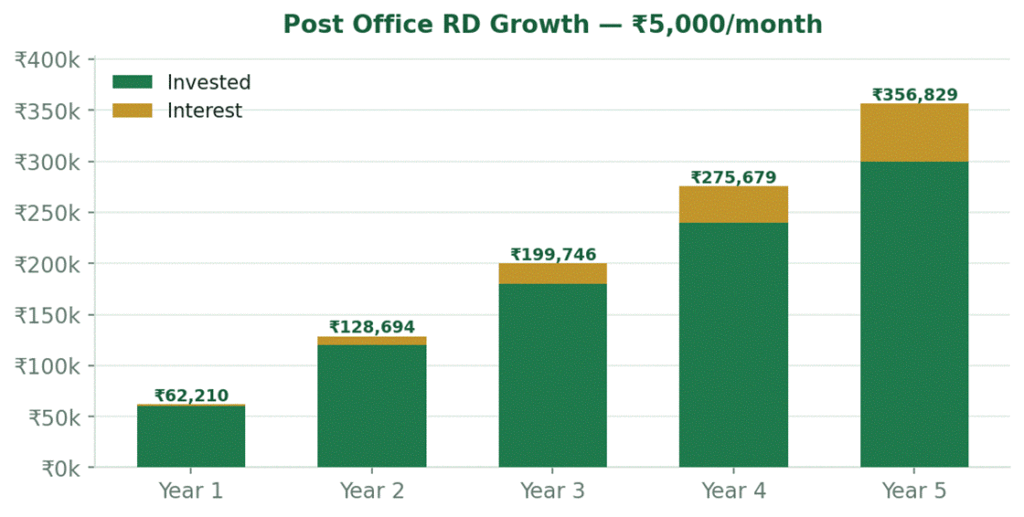
Over five years, ₹3,00,000 invested becomes about ₹3,56,829 — an interest of ₹56,829, or a 18.9% total return.
How to Use the Post Office RD Calculator
- Enter your monthly deposit — from ₹100, in multiples of ₹10.
- Add any installments paid in advance to see the rebate you earn.
- Choose a premature-closure option to see the early-exit value.
- Click Calculate for maturity, total interest and the year-by-year table.
Advanced Features of Our RD Calculator
Advance Deposit Rebate
If you pay six or more months in advance, the Post Office gives a rebate. The calculator shows the exact amount — for example, 12 advance deposits earn ₹40 per ₹100 of monthly deposit.
Post Office RD Premature Closure Calculator
You can close an RD after three years, but interest is then paid only at the 4% savings rate. The post office RD premature closure calculator shows this reduced value and what you forgo.
Loan Against Your RD
After one year and 12 deposits, you can borrow up to 50% of your balance at the RD rate plus 2%. The tool shows your loan limit at a glance.
Post Office RD Calculator for Senior Citizens
The Post Office RD does not offer a separate senior-citizen rate — everyone earns the same 6.70%. So a post office RD calculator for senior citizens uses the same figures as for other savers.
Seniors wanting higher, regular income may prefer SCSS or Post Office MIS, but the RD remains a safe, disciplined way to save.
Advantages of a Post Office RD
- Government-backed and fully secure, available at any post office.
- Start with as little as ₹100 a month — ideal for small, regular savings.
- A fixed 6.70% return, unaffected by market swings.
- Advance-deposit rebate, loan facility and a 5-year extension option.
- Digital access through India Post Payments Bank (IPPB) and Indian Post online.
Post Office RD vs Bank RD
Bank RDs — such as an IPPB RD or a KVB RD — let you pick the tenure and rate, while the Post Office RD has a fixed 6.70% for five years.
The Post Office RD suits savers who want a simple, government-backed option; bank RDs suit those who want flexible tenures.
For bank deposits, compare options with our FD rates comparison, or model a lump sum with our Post Office TD calculator.
Tax on Post Office RD
RD interest is fully taxable as income from other sources, and the Post Office RD does not qualify for Section 80C.
If your interest is large, read our guide on tax on FD interest — the same rules apply to RD interest. See scheme details on the India Post savings page.
Frequently Asked Questions (FAQs)
What is the Post Office RD interest rate in 2026?
6.70% per year, compounded quarterly, for a fixed 5-year term.
How much is ₹1,000 per month for 5 years in Post Office RD?
About ₹71,366 at maturity — ₹60,000 invested plus roughly ₹11,366 interest.
How much will ₹5,000 per month give in Post Office RD?
Around ₹3,56,829 after 5 years, including about ₹56,829 in interest.
What is the minimum Post Office RD deposit?
₹100 per month, in multiples of ₹10, with no maximum limit.
Can I close my Post Office RD early?
Yes, after 3 years, but interest is then paid only at the 4% Post Office Savings rate.
Does the Post Office RD have a senior-citizen rate?
No. The 6.70% rate is the same for all depositors, including senior citizens.
Can I take a loan against my Post Office RD?
Yes, up to 50% of the balance after 1 year and 12 deposits, at the RD rate plus 2%.
Is Post Office RD interest taxable?
Yes, RD interest is fully taxable as income from other sources, and it does not qualify for Section 80C.
Can I open a Post Office RD online?
Yes, through India Post internet banking or the India Post Payments Bank (IPPB) app.
What happens if I miss a Post Office RD deposit?
Up to four missed deposits can be paid with a small revival fee; more than four discontinues the account.
Final Thoughts
A post office RD calculator 2026 makes it easy to plan a safe, disciplined savings habit and see exactly what your monthly deposits will grow to.
Check different amounts, plan advance deposits, and confirm the current rate on the official India Post site before you invest.