Tax on FD Interest 2026: TDS Rules, Limits & Form 15G/15H Explained
Fixed deposits are safe, but the interest they earn is taxable. Understanding the tax on FD interest 2026 helps you avoid surprise deductions and claim back anything extra.
This guide explains how FD interest is taxed, the latest TDS on FD rates and limits, Form 15G and 15H, refunds, and simple ways to pay less tax.
Is FD Interest Taxable in 2026?
Yes. Interest from every fixed deposit — bank, small finance bank, NBFC or post office — is fully taxable in India.
It is added to your income under the head Income from Other Sources and taxed at your applicable slab rate.
There is no special lower rate for FD interest. A tax-saver FD saves tax on the deposit under Section 80C, but its interest is still taxable.
How Is FD Interest Taxed?
Your bank reports the interest to the Income Tax Department, and it is taxed at whatever slab your total income falls into.
Tax Deducted at Source (TDS) is only an advance collection. Your final tax depends on your total income for the year, not on the TDS alone.
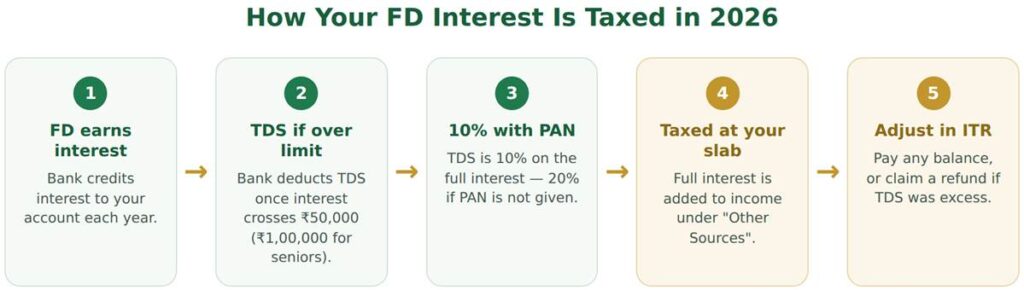
So a person in the 30% slab ends up paying more than the 10% TDS, while someone with low income can get the full TDS back as a refund.
TDS on FD: Rates for 2026
Banks deduct TDS at 10% when your FD interest crosses the annual threshold, provided your PAN is registered.
If you have not given your PAN, the rate doubles to 20%, so always keep your PAN updated with every bank.
TDS is deducted when interest is credited each year — not only at maturity — and for joint FDs it is booked under the first holder.
TDS Threshold Limits for 2026
Budget 2025 raised the TDS-free interest limits from April 2025, and they continue unchanged in 2026.
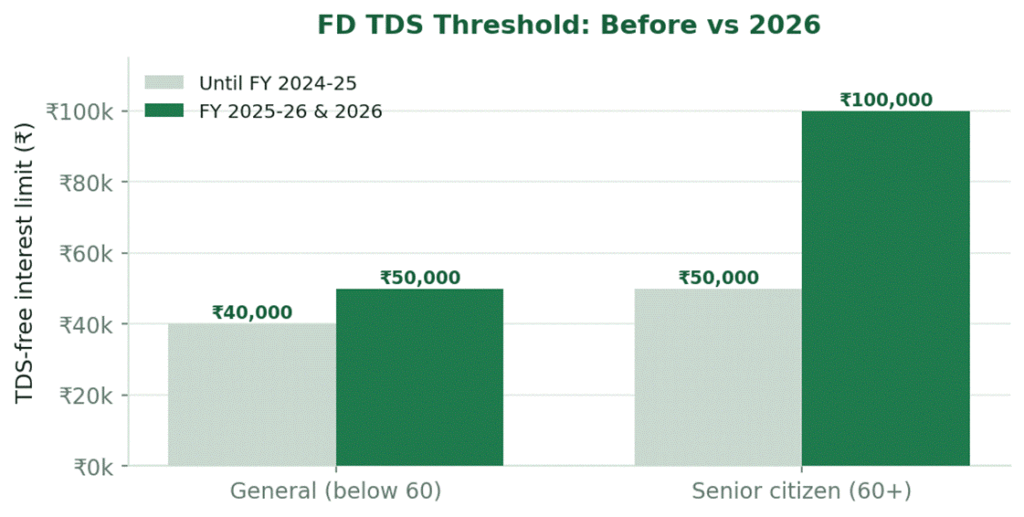
| Depositor | Until FY 2024-25 | FY 2026 limit | TDS rate |
| Below 60 years | ₹40,000 | ₹50,000 | 10% (20% no PAN) |
| Senior citizen (60+) | ₹50,000 | ₹1,00,000 | 10% (20% no PAN) |
The limit is counted per bank, aggregated across all its branches under Core Banking. Interest from different banks is not added together for TDS.
TDS Applies to the Full Interest, Not Just the Excess
A common myth is that TDS applies only to interest above the limit. In reality, once you cross the threshold, TDS is charged on the entire interest.
Example: ₹80,000 interest for a general depositor crosses ₹50,000, so the bank deducts 10% on the whole ₹80,000 — that is ₹8,000, not ₹3,000.
TDS Is Not Your Final Tax
TDS is only a part-payment. Your real tax on FD interest depends on your slab, and the two are rarely the same.
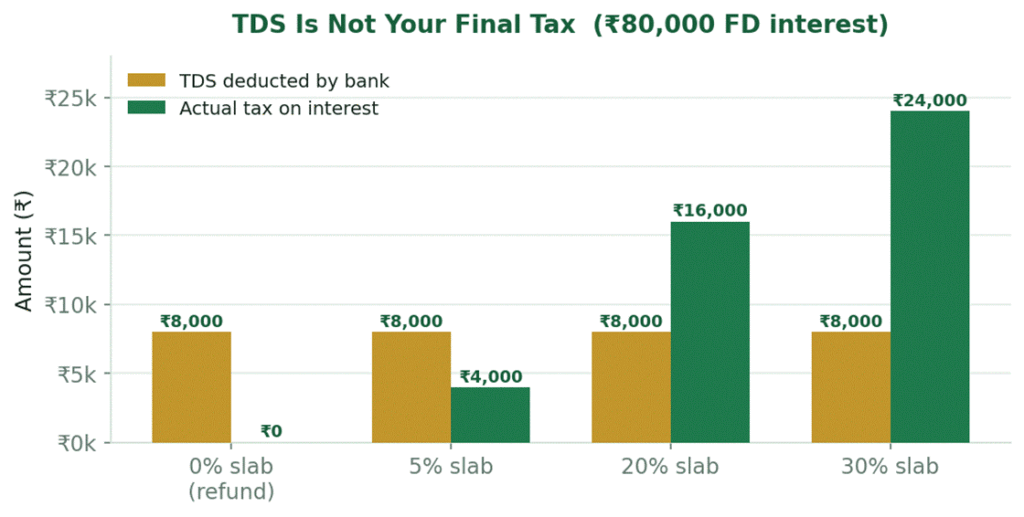
In the example, ₹8,000 TDS is deducted on ₹80,000 interest. A 30% slab taxpayer owes ₹24,000 and pays the ₹16,000 balance; a nil-tax person claims the full ₹8,000 back.
Worked Example: Tax on a ₹5,00,000 FD
Say you invest ₹5,00,000 in a one-year FD at 7%. It earns about ₹35,000 in interest, which is below the ₹50,000 limit, so no TDS is deducted.
But the ₹35,000 is still taxable. You add it to your income and pay tax at your slab — for a 20% taxpayer, that is roughly ₹7,000.
Now take a ₹10,00,000 FD earning ₹70,000. It crosses the limit, so the bank deducts ₹7,000 as TDS, and you settle the balance or claim a refund based on your slab.
Form 15G and Form 15H: Stop Unnecessary TDS
If your total income is below the taxable limit, you can ask the bank not to deduct TDS by filing a simple self-declaration.
Form 15G (Below 60)
Form 15G is for residents under 60 (and HUFs) whose total income is below the basic exemption limit and whose total interest is within limits.
Form 15H (Senior Citizens)
Form 15H is for residents aged 60 and above whose final tax on total income for the year works out to nil. There is no interest ceiling for 15H.
How and When to Submit
Submit the form to each bank separately, at the start of every financial year, before the interest is credited.
You can usually file it through net banking. If TDS is already cut, it cannot be reversed by the bank — you must claim it back in your return.
Section 80TTB and 80TTA: Extra Relief on Interest
Senior citizens can deduct up to ₹50,000 of interest income from FDs, RDs, savings and post office deposits under Section 80TTB, in the old regime.
Others can claim up to ₹10,000 on savings-account interest under Section 80TTA, but this does not cover FD interest. Neither deduction is available in the new regime.
Is a Tax-Saver FD Different?
A 5-year tax-saver FD lets you claim the deposit — up to ₹1.5 lakh — under Section 80C in the old regime, which a normal FD does not offer.
However, the interest on a tax-saver FD is taxed exactly like any other FD, and TDS applies in the same way once it crosses the threshold.
How to Claim a TDS Refund on FD Interest
If more TDS was deducted than your actual tax, file your income tax return to claim the excess as a refund.
Check the TDS already deducted in your Form 26AS or AIS and make sure it matches what you report. You can verify these on the official Income Tax portal; refunds are usually credited within a few weeks.
How to Check the TDS Deducted on Your FD
Every rupee of TDS the bank deducts is reported against your PAN, so you can verify it before you file.
Your Form 26AS and the Annual Information Statement (AIS) on the Income Tax portal list all TDS entries for the year, and the bank issues Form 16A for the TDS on your interest.
Always match these figures with your own records. If the TDS in your return does not match Form 26AS, your refund can be delayed.
FD Interest Under the New vs Old Tax Regime (2026)
FD interest is taxable under both regimes. The difference lies in the deductions you can use to lower it.
The old regime allows 80TTB and 80C; the new regime has wider slabs and a rebate that makes income up to ₹12 lakh effectively tax-free, but without 80TTB.
Choose the regime that gives you the lower overall tax after including your FD interest.
Post Office and Small Savings: How TDS Applies
India Post generally does not deduct TDS on schemes like Post Office TD and NSC, but the interest is still taxable and must be declared.
Model these returns with our Post Office TD calculator and NSC calculator, and remember to add the interest to your return.
A Quick Note on RDs, Company FDs and NRIs
Recurring deposits follow the same TDS rules as FDs, and the ₹50,000 or ₹1,00,000 limit applies to your combined RD and FD interest in a bank.
Company and NBFC fixed deposits also deduct TDS, usually once interest crosses just ₹5,000 in a year — a far lower limit than banks.
For NRO deposits held by NRIs, TDS is deducted at a much higher rate of around 30% plus surcharge and cess, and Form 15G or 15H cannot be used.
Smart Ways to Reduce Tax on FD Interest
- Submit Form 15G or 15H on time if your total income is below the taxable limit.
- Split large deposits across banks or eligible family members to stay within thresholds.
- Spread interest across years with FD laddering instead of one large payout.
- Senior citizens: use the ₹50,000 Section 80TTB deduction in the old regime.
- Always keep your PAN updated with the bank to avoid the higher 20% rate.
Learn the laddering approach in our FD laddering calculator.
Common TDS Mistakes to Avoid on FDs
- Assuming FD interest is tax-free just because no TDS was deducted — it is always taxable.
- Forgetting to add interest from every bank and branch when filing your return.
- Submitting Form 15G or 15H when your income is actually above the taxable limit.
- Not updating your PAN, which triggers the higher 20% TDS rate.
- Filing 15G or 15H once and assuming it carries over — it must be given every financial year.
Calculate Your FD Tax in Seconds
Instead of doing the math by hand, use our FD Tax / TDS calculator to see the TDS and your slab tax instantly, then plan with our FD rates comparison.
Frequently Asked Questions (FAQs)
Is FD interest taxable in 2026?
Yes. FD interest is fully taxable under Income from Other Sources at your slab rate. TDS is only an advance collection, not the final tax.
What is the TDS limit on FD interest in 2026?
₹50,000 for depositors below 60 and ₹1,00,000 for senior citizens, counted per bank in a financial year.
What is the TDS rate on FD?
10% if your PAN is registered, and 20% if it is not, once the interest crosses the threshold.
Is TDS deducted on the full interest or only the excess?
On the full interest once you cross the threshold, not just the amount above it. ₹80,000 interest attracts 10% TDS on the whole ₹80,000.
How can I avoid TDS on my FD?
Submit Form 15G if you are below 60, or Form 15H if you are a senior citizen, provided your total income is below the taxable limit.
Does the post office deduct TDS on FD or TD?
India Post generally does not deduct TDS on Post Office TD or NSC, but the interest is still taxable and must be declared.
Can I get a refund of TDS deducted on my FD?
Yes. File your income tax return and any TDS deducted in excess of your actual tax is refunded to your bank account.
Is TDS deducted every year or only at maturity?
Every year when the bank credits interest, not only at maturity.
Do senior citizens get extra relief on FD interest?
Yes. They can claim up to ₹50,000 under Section 80TTB in the old regime, and enjoy the higher ₹1,00,000 TDS limit.
Is FD interest taxed under the new tax regime?
Yes, but you cannot claim 80TTB or 80C. The new regime rebate makes total income up to ₹12 lakh effectively tax-free.
Final Thoughts
FD interest is safe income, but it is fully taxable — and TDS is only the first step, not the final bill.
Know your 2026 limits, file Form 15G or 15H when eligible, and reconcile TDS in your return. Always confirm current rules on the official Income Tax portal before filing.